
Manuscript Archaeology
Oriental 4445, Layer by Layer (part II)

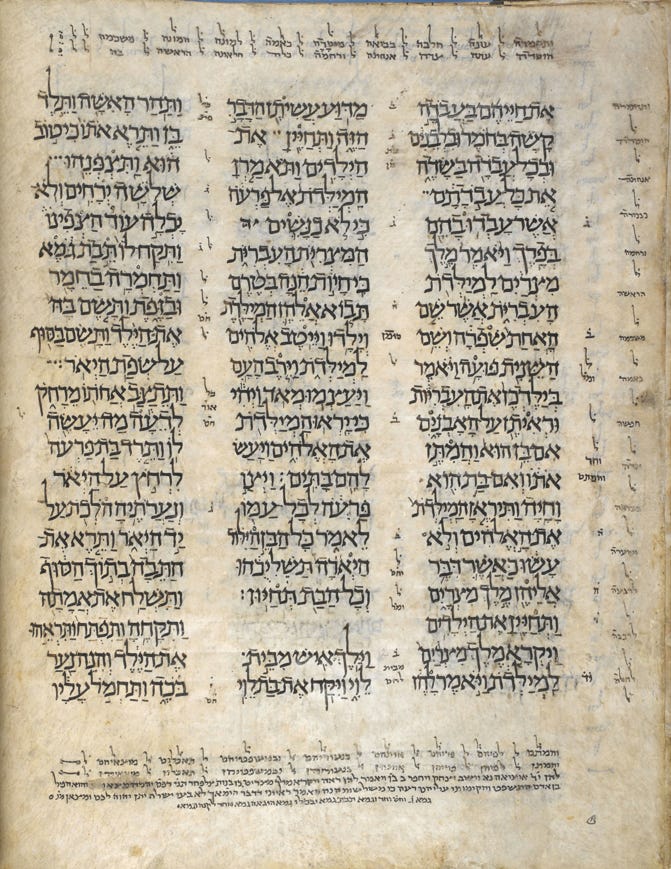
In the first part of this tortuous process I showed how the scribe behind the rather lovely Or. 4445 hid/revealed his name, and possibly a location, among the masoretic notes. Shaqlawa was the location in question, in modern day NE Iraq.
I mentioned there was at least one other tantalising bit of evidence to link this manuscript to Persia. So…
…Given the hints towards the Persian provenance of the manuscript, it seems natural to conduct some sort of comparison between the original parts of Or. 4445 and other early biblical manuscripts thought to be of Persian origin. This is not as straightforward as one could wish. There are hardly any early (i.e., 10th to 12th centuries) Hebrew Bible manuscripts that we can positively locate to this area. Only 4 in fact… and two of those are inaccessible… and one of the others is too fragmentary to be much use…
So that leaves us with just one: NLI Heb. 8° 2238 (which I’ve written a bit about here)
NLI Heb. 8° 2238 is a beautifully crafted manuscript containing (from its inception) a single parashah: parashat shlakh lkha (Numbers 13–15). The colophon dates the manuscript to 1107. Previous scholars have suggested a Persian provenance on the basis of the style of the manuscript’s (lavish) ornamentation, a Persian ownership colophon, and on the basis of other, similar, manuscripts now located in the Meshed Shrine Library, Iran:
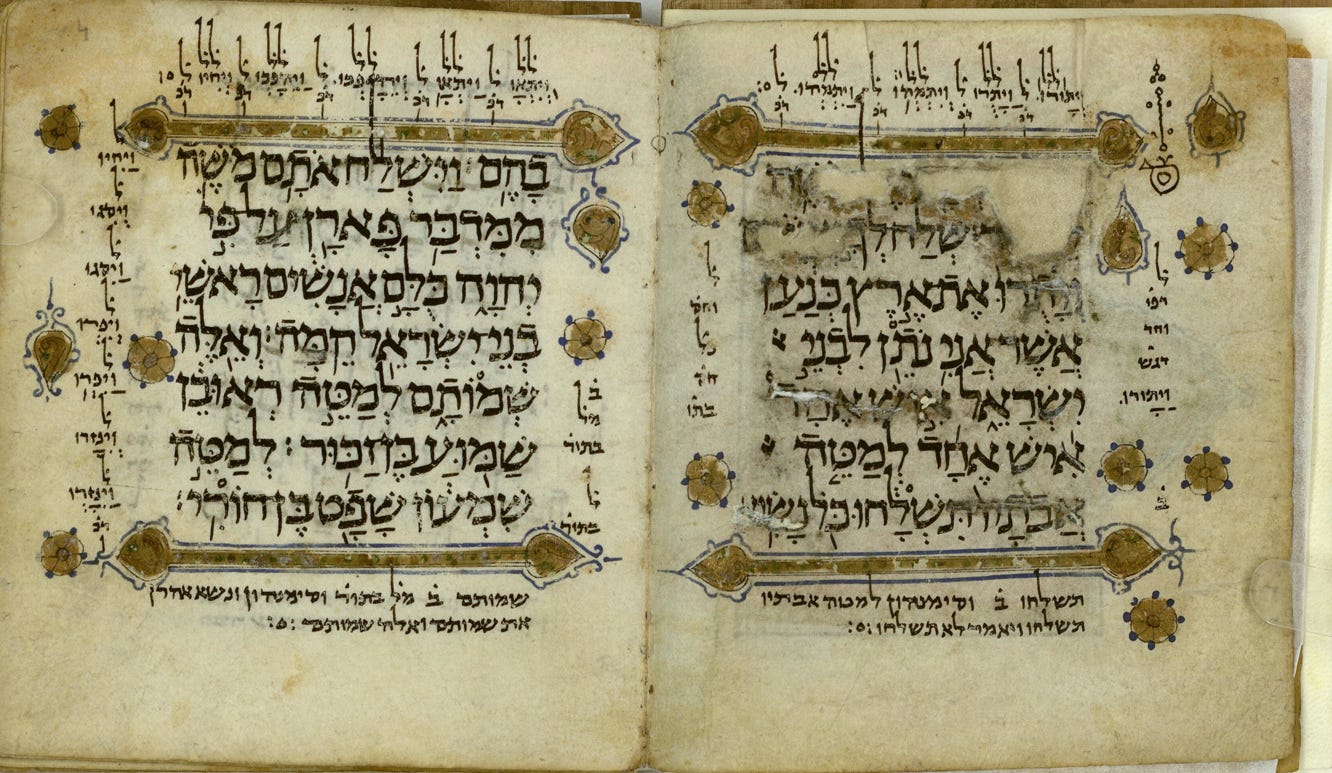
NLI Heb. 8° 2238
The thing that links this manuscript to Or. 4445 is a strangely-worded masoretic note found in both codices, at Numbers 13:22:
וַיַּעֲל֣וּ בַנֶּגֶב֮ וַיָּבֹ֣א עַד־חֶבְרוֹן֒
“They went up into the Negev and came to Hebron”
The text is describing the movements of the twelve spies sent to reconnoitre the promised land. In the middle of a long string of plural vayyiqtol verb forms (“they went… they found… they took…” etc) the singular form ויבא appears ‘He came’, even though its still describing the activities of the twelve spies. Odd.
It is a classic context for a sevirin masoretic note. This is where the masoretes would point out an odd form and say: ‘you might expect xyz, but actually the text has abc’. In this case, we would obviously expect a plural verb rather than a singular.
Sure enough, a variety of related sevirin notes are found at this point in the major masoretic Bible codices. The ad loc. masora parva note in the Leningrad codex, for example, reads: ח’ סבר’ לשון רבים “One of the 8 places where you might expect a plural form”…
The thing about masoretic notes is that they tend to use quite rigid formulae and technical terms. In the note above סבירין ‘sevirin’ is the technical masoretic term for ‘you might expect’, and רבים ‘rabbim’ is the grammatical term for ‘plural’.
The weird thing is that the same note appears in Or. 4445 and NLI Heb. 8° 2238, but in both manuscripts the note is phrased using very unusual terminology. Here’s the note in Or. 4445:

חד מן ח דקריין לשון חד וחמיין לשון סגי
And here it is in NLI Heb. 8° 2238:
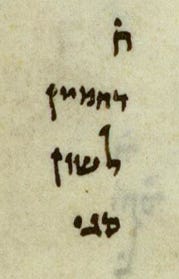
ח’ דחמיין לשון סגי
Both notes replace the expected term sevirin with the term חמיין ‘hamayn’, and the term rabbim with the Aramaic סגי ‘saggi’. Very, very unusual indeed.1 To give you an idea of just how unusual: the largest collection of masoretic notes ever made is by Ginsburg. In a work of over 2500 pages, the term חמיין appears only three times. And even those three are references not to an actual manuscript, but to a set of masoretic notes compiled in the early 16th century for the massively influential Second Rabbinic Bible.2
So, what does it mean that the same oddly phrased note is found in both these manuscripts? Coincidence? Maybe. Did the scribe of NLI Heb. 8° 2238 have Or. 4445 in front of him when he wrote? Did both manuscripts rely on some local masoretic source? With just one note we can’t say anything with certainty. But, one way or the other, it’s another intriguing connection between Or. 4445 and Persia. And there are plenty more to come.
The use of the term חמיין reminds one of the Babylonian Masoretic term חזיין, the standard Babylonian equivalent of sevirin. The use of the root חמי in this sense, however, is most unusual. Ofer does not include it, for example, in his list of Babylonian masoretic terminology (Ofer 2001, 584–585). Likewise, the use of סגי instead of רבים is most unusual, though to a lesser degree.
A bit of caution is necessary here. Ginsburg gathered his masoretic notes mainly from later manuscripts, and no-one has yet compiled a significant proportion of masoretic notes from the early, high quality Tiberian masoretic Bibles. This is one of the aims of the organisation I work for: the Institute for Hebrew Bible Manuscript Research. Watch this space…
What I can say is that this term does not occur anywhere in the masora of the Aleppo Codex, or in the Leningrad Codex, or in the ten or so early manuscripts I checked ad loc.
Isn’t strange that a Persian scribe would use the Western Aramaic חמי rather than the Eastern חזי? Does this man the he was copying from a source that originated in Tiberias?
Dear Dr. Kim,
Thank you so much for writing part II of manuscript archaeology.
Blessings,
Rimon Armaly