The Ashkar-Gilson Scroll
A Voice from the Silent Era

Things fall apart. Including parchment/leather manuscripts.
So it’s not really that surprising that we have so few Hebrew manuscripts (including Bible manuscripts) from the first Christian millennium.
Like—hardly any. Between the latest of the scrolls from the Judean Desert (roughly AD 100) and the explosion of preserved Hebrew manuscripts from about AD 850 onwards we have a tiny number of Hebrew manuscripts. One or two dozen, maybe.
This 750 year period is sometimes referred to as the Silent Era of Hebrew manuscripts.
Every manuscript from this period carries a particular importance, therefore, since they are so few and far between.
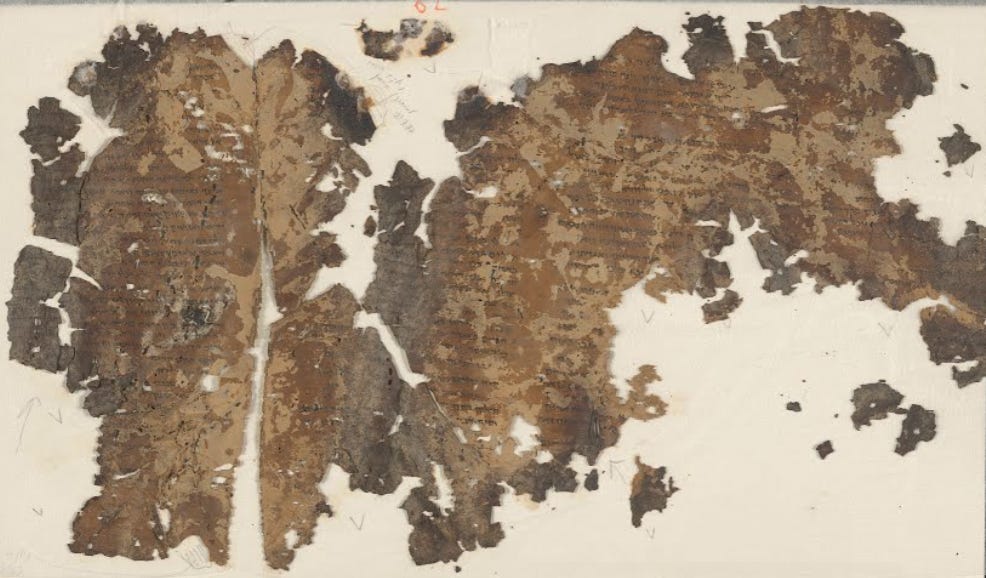
Part of the Minor Prophets Scroll from Wadi Murabba’at. Among the latest of the Hebrew Bible materials found in the Judean Desert (about AD 135).
The Cairo Genizah is the most important trove of manuscripts containing some treasures from the latter part of this silent period. And the Ashkar-Gilson scroll is one of the most important manuscripts from this trove.
The Ashkar-Gilson Scroll
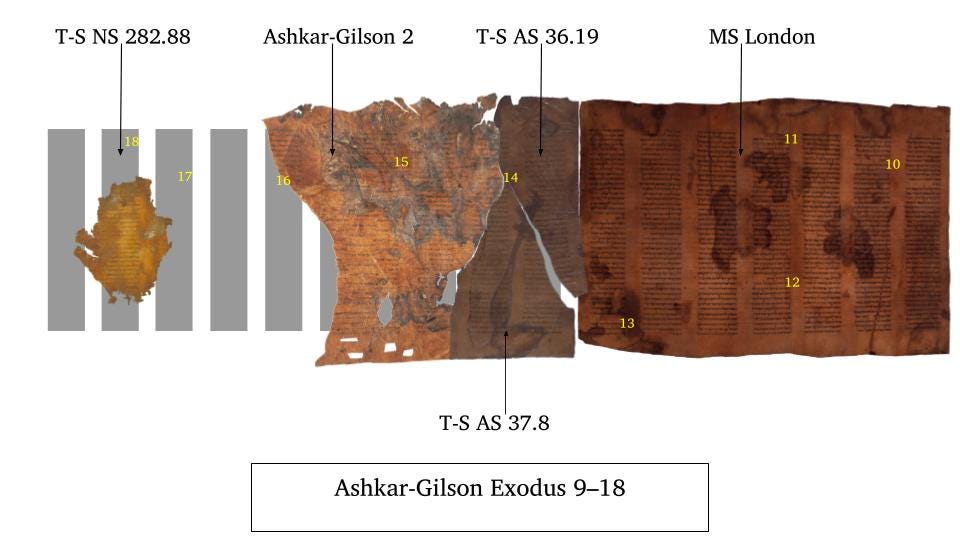
In 1959 the Hebrew palaeographer Birnbaum examined a large sheet containing seven complete columns of text (Exodus 9—13) that once belonged, it seemed, to a complete Torah Scroll. The fragment was held in Jews’ College, London, and hence is often referred to as the London Manuscript. He concluded, on the basis of the script, that the sheet was exceptionally old—from the 8th century.
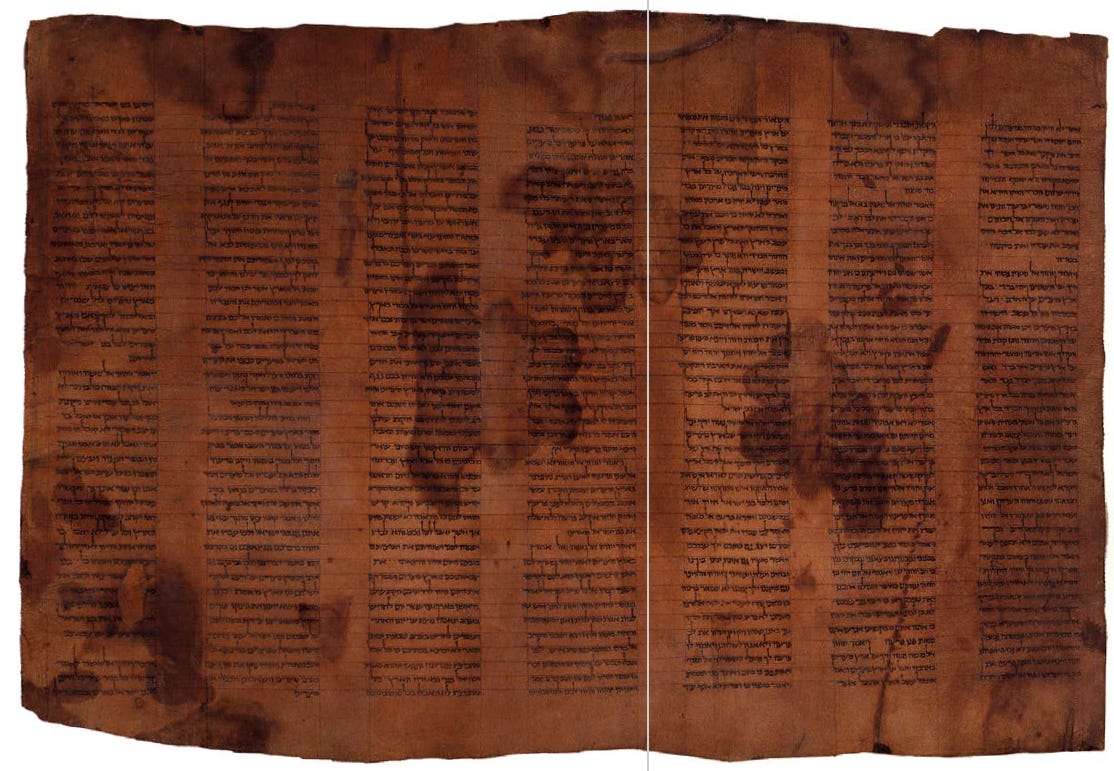
The London Manuscript, dated by Birnbaum to the 8th century.
In 1972 a crack commando unit was sent to prison by a military court for a crime they didn’t commit. Also that year, manuscript collectors Dr Faud Ashkar and Albert Gilson acquired some fragments of Hebrew Torah scrolls from Lebanon. Towards the end of that decade Ashkar solicited the advice of the well-known scholar of the Dead Sea Scrolls, James H. Charlesworth—then of Duke University—and eventually donated 23 Torah scroll fragments to Duke University.
Charlesworth was particularly interested in one fragment containing portions of Exodus 14—16, and had the piece dated using Carbon-14 double-blind testing. The results were unanimous: the piece was from the 7th-8th century. The fragment—now referred to as the Ashkar-Gilson fragment—quickly became a minor-celebrity: a securely dated fragment of the Hebrew Bible from the Silent Era!
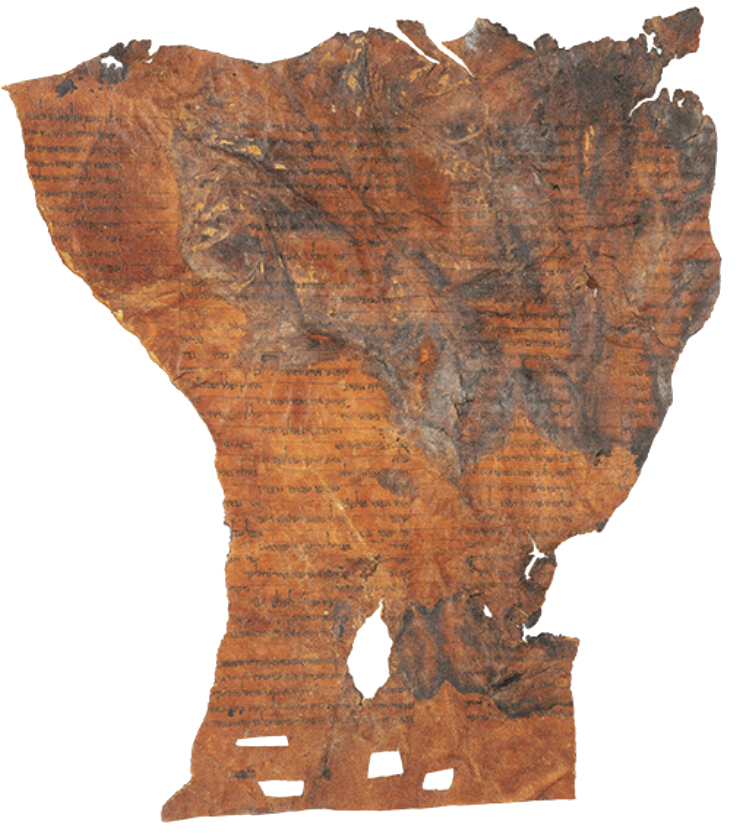
The Ashkar-Gilson Fragment - dated by C-14 testing to the 7th/8th centuries.
It wasn’t until the end of the first decade of the 21st century that two Israeli scholars: Edna Engel and Mordechay Mishor, demonstrated that the London Manuscript and the Ashkar-Gilson fragment are in fact originally from the same scroll. Birnbaum’s palaeographic dating of the London Manuscript was thus confirmed by, and supported, the 7th/8th century date arrived at by the C-14 testing of the Ashkar-Gilson fragment.
So now we’re dealing with the London-Ashkar-Gilson Scroll!
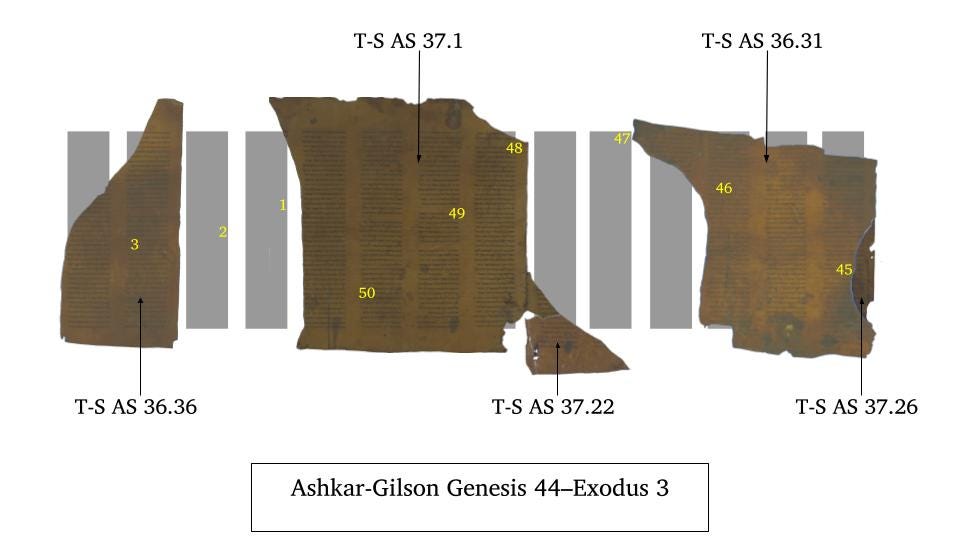
The next leap forward happened in 2019, when Mordechai Veintrob, then researching early scrolls for his Master’s thesis, found no few than 13 further pieces from the same original 7th/8th century scroll, eleven of which are kept today in the Taylor-Schechter Genizah Collection in Cambridge University Library.
Rather than refer to this scroll as the Veintrob-Taylor-Schechter-London-Ashkar-Gilson Scroll, I and others refer to the 7th/8th century scroll simply as the Ashkar-Gilson Scroll.
So, today, we are talking about no fewer than 15 pieces from this ancient scroll: about 10% of the entire Torah, preserved in various collections over the world. It is a stunning voice from the Silent Era of Hebrew Bible manuscripts.
A stunning voice from the Silent Era of Hebrew Bible manuscripts…
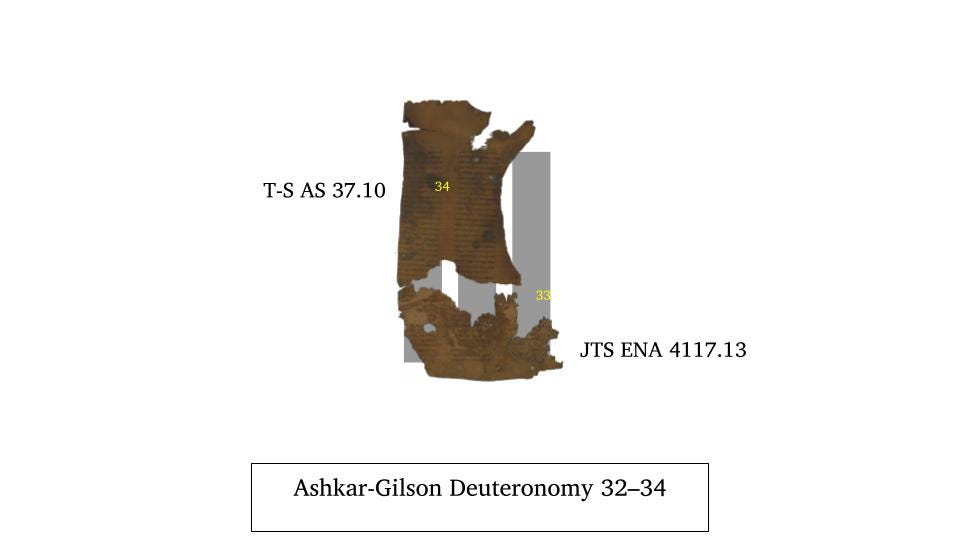
Twelve of the fragments fit together rather nicely to form three manuscript clusters: one from the end of Genesis/beginning of Exodus, one from Exodus 9—18, and one from the end of Deuteronomy. In the diagrams below I’ve been able to line up the fragments so that the original column layout can be seen. Enjoy!